
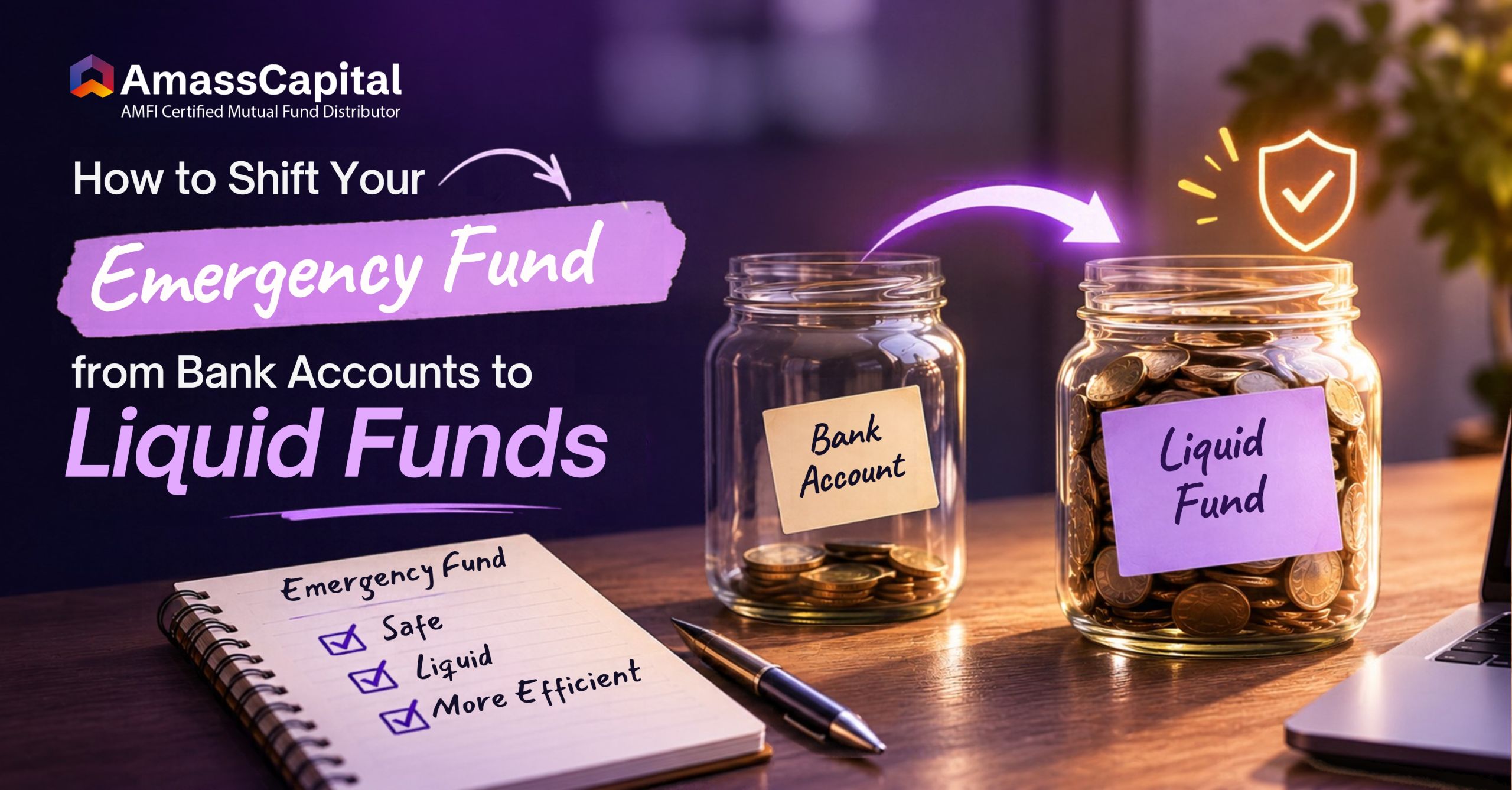
An emergency fund is money you hope you never need, but should always be able to access.
A sudden hospital bill, an unexpected job loss or an urgent home repair can disrupt even a carefully planned monthly budget. That is why financial planning usually begins with keeping money aside for emergencies.
Most Indians maintain this reserve in a savings bank account. It is familiar, convenient and easy to access. However, as the balance grows, you may wonder whether part of it could be managed differently.
This is where the search for the best liquid funds for emergency fund planning begins.
Liquid mutual funds can be useful for holding a portion of your emergency savings. But they are not replacements for every rupee in your bank account, and they do not offer guaranteed returns.
The important question is not simply where you might earn more. It is where your money will be available when you need it.
Why Your Emergency Fund Should Come Before Investing
Imagine you earn ₹60,000 per month and your essential household expenses are ₹35,000.
If you lose your income temporarily, expenses such as rent, groceries, electricity, insurance and loan EMIs will continue.
An emergency fund gives you time to manage such situations without immediately selling long-term investments or borrowing money. Understanding the importance of long-term wealth creation through mutual funds can also help you keep emergency savings separate from investments intended for future goals.
A commonly used starting point is three to six months of essential expenses. People with irregular income, significant family responsibilities or uncertain employment may prefer a larger reserve.
For someone spending ₹35,000 monthly, a six-month emergency fund would be:
₹35,000 × 6 = ₹2,10,000
This money should prioritise accessibility and capital preservation over return maximisation.
Liquid Funds vs Savings Account: What Is the Difference?
A savings account is a bank deposit. It allows withdrawals through banking channels and generally earns interest at the rate offered by the bank.
A liquid mutual fund is a type of debt mutual fund that invests in short-term money-market and debt instruments with residual maturities of up to 91 days.
Liquid funds are designed for short-term cash management, but their net asset values can fluctuate. Investors comparing different mutual fund investment options should understand these differences before deciding where to place their money.
Table 1: Liquid Funds vs Savings Account in India
| Comparison Factor | Savings Bank Account | Liquid Mutual Fund |
| Type of financial product | Bank deposit | Debt mutual fund |
| Access to money | Usually immediate through available banking channels | Subject to redemption processing |
| Returns | Interest at the bank’s declared rate | Market-linked returns; not guaranteed |
| Capital protection | Eligible deposits covered by DICGC insurance within prescribed limits | No deposit insurance or capital guarantee |
| Market risk | No mutual fund NAV fluctuation | Exposed to interest-rate and credit risks |
| Withdrawal method | ATM, UPI, bank transfer or branch withdrawal | Redemption through AMC or investment platform |
| Best suited for | Immediate emergency expenses | Secondary emergency reserve |
| Tax treatment | Savings interest generally taxable, subject to applicable deductions | Capital gains taxation under applicable mutual fund rules |
Under India’s deposit insurance framework, eligible deposits are insured by the Deposit Insurance and Credit Guarantee Corporation (DICGC) up to ₹5 lakh per depositor per bank, including principal and interest, subject to applicable conditions.
Mutual funds do not receive this protection.
This distinction matters when comparing liquid funds vs savings account options. A potentially higher yield does not make a liquid fund equally safe or equally accessible.
Where to Park an Emergency Fund in India
Instead of keeping your entire emergency reserve in one place, consider separating it according to when you might need the money.
For example, suppose your emergency fund is ₹2,10,000.
Table 2: Example of an Emergency Fund Allocation
| Emergency Fund Component | Illustrative Amount | Purpose |
| Savings bank account | ₹70,000 | Immediate bills, medical expenses and urgent withdrawals |
| Liquid mutual fund | ₹1,40,000 | Additional reserve for emergencies |
| Total emergency fund | ₹2,10,000 | Six months of essential expenses |
This is only an illustration, not a recommended allocation for everyone.
If you have unpredictable medical expenses, limited banking access or highly irregular income, maintaining a larger amount in your savings account may be more suitable.
The aim is to avoid depending entirely on a mutual fund redemption during an urgent situation.
How to Choose the Best Liquid Funds for Emergency Fund Planning
There is no single liquid fund that is best for every investor.
A fund offering the highest recent return may not necessarily be the most suitable place for emergency money.
When comparing schemes, pay attention to four practical factors.
Portfolio quality: Review the types of debt instruments held by the fund, their credit quality and issuer concentration. Higher yields may sometimes reflect additional risks.
Expense ratio: A fund’s expenses reduce the return investors ultimately receive. Compare costs alongside portfolio quality rather than treating either factor in isolation.
Liquidity and redemption arrangements: Understand how the fund processes withdrawal requests and whether it offers an instant-access facility.
Consistency and risk disclosures: Review the scheme information document, portfolio disclosures, riskometer and relevant AMC updates. Making better mutual fund investment decisions involves evaluating these details rather than relying only on recent performance.
Emergency savings are different from long-term investments. Their primary purpose is to remain available during difficult circumstances.
What Liquid Mutual Fund Return Rate Should You Expect?
The liquid mutual fund return rate is not fixed like a contracted bank FD interest rate.
Liquid fund returns depend on prevailing short-term interest rates, portfolio holdings, expenses and market conditions.
For example, if ₹1,00,000 earns a hypothetical annualised return of 6%, the gain over one year would be approximately ₹6,000 before tax, assuming that return is achieved.
This is a mathematical illustration, not a forecast or promise.
The actual return may be higher or lower, and even short-term debt funds can experience losses.
Avoid selecting a fund solely because its recent seven-day or 30-day annualised yield appears attractive.
How to Shift Part of Your Emergency Fund to Liquid Funds
Moving emergency savings does not need to happen all at once.
Start by calculating your essential monthly expenses and deciding how much money must remain immediately available.
Next, review your existing savings account balance, upcoming payments and any foreseeable financial obligations.
Once you have identified an amount that is unlikely to be needed immediately, compare suitable liquid mutual fund schemes.
Complete the required KYC and investment formalities through a legitimate AMC, authorised distributor or investment platform.
Before investing, read the scheme’s risk disclosures, redemption terms, applicable cut-off timings and exit-load provisions.
You may prefer transferring the selected amount in stages rather than moving a large balance in a single transaction. If you are also planning regular investments towards other financial goals, a monthly SIP guide based on salary can help you understand how to organise those contributions separately from your emergency reserve.
Finally, check your emergency fund periodically. If household expenses rise or your financial responsibilities change, the reserve may need adjustment.
Instant Redemption Liquid Funds: Can You Withdraw Anytime?
Some AMCs offer instant redemption liquid funds through an instant-access facility.
Under SEBI’s framework, where this facility is offered, instant redemption is generally limited to ₹50,000 or 90% of the folio value, whichever is lower, per day per scheme.
This facility is subject to the AMC’s terms, eligibility requirements and operational availability.
Normal redemptions are typically processed on a T+1 working-day basis, subject to applicable rules, cut-off timings and intervening holidays.
Therefore, the liquid mutual fund redemption time may differ from the time needed to withdraw money from a savings account.
If an emergency occurs late at night, during a banking holiday or when an instant facility is unavailable, you should not assume the full invested amount can be accessed immediately.
That is why keeping some emergency cash in a savings account remains important.
Understanding Tax on Liquid Funds in India
Taxation is another important consideration before shifting money.
For most liquid fund units acquired on or after 1 April 2023, gains are generally taxed at the investor’s applicable income-tax slab rate under the rules for specified mutual funds, irrespective of the holding period.
For units purchased earlier, treatment can differ based on the acquisition date and applicable capital-gains provisions.
Tax rules may also change, and individual circumstances matter. Investors considering different ways to organise their financial protection may also review suitable insurance options alongside their emergency savings.
Unlike savings account interest, which is generally taxable annually, capital gains on liquid fund units are ordinarily considered when the units are redeemed or otherwise transferred.
Investors should verify the applicable provisions for the relevant financial year before making tax-related decisions.
Final Thoughts: Your Emergency Fund Needs Access, Not Just Returns
An emergency fund is not meant to outperform the market.
It exists to protect your household from unexpected financial pressure.
Liquid mutual funds can serve as an additional place to hold part of that reserve, provided you understand their risks, taxation and withdrawal timelines.
For many investors, combining immediate bank liquidity with a carefully evaluated secondary reserve may be more practical than choosing one option exclusively.
At AmassCapital, we encourage investors to understand the purpose of their money before selecting a financial product.
Planning your emergency fund? Explore your options with AmassCapital and understand the differences between bank deposits and liquid mutual funds before making a decision.
Frequently Asked Questions (FAQs)
1. Are liquid funds safer than bank FD for emergency savings?
No. Liquid funds and bank fixed deposits have different risk characteristics. Eligible bank FDs receive DICGC deposit insurance up to ₹5 lakh per depositor per bank, including principal and interest, subject to prescribed conditions. Liquid funds are market-linked mutual funds without deposit insurance or guaranteed capital protection.
2. How much money should I keep in a liquid fund for emergencies?
There is no fixed percentage suitable for everyone. First calculate three to six months of essential expenses, or more if your income is irregular. Keep enough money in your savings account for immediate needs. You can then evaluate whether part of the remaining emergency reserve belongs in a liquid fund.
3. What is the tax on liquid funds for financial year 2026–27?
For tax year 2026–27, Section 76 of the Income-tax Act, 2025 (earlier Section 50AA of the Income-tax Act, 1961) treats gains from qualifying liquid fund units acquired on or after 1 April 2023 as short-term capital gains, irrespective of the holding period, taxed at applicable slab rates. The current definition of specified mutual funds has applied since 1 April 2025. Older holdings may require separate treatment.
4. What is the liquid mutual fund redemption time in India?
Standard liquid fund redemptions are generally settled on a T+1 working-day basis, subject to applicable processing rules and holidays. Some AMCs offer instant redemption facilities, but availability and limits vary. Always verify the particular scheme’s redemption arrangements before relying on it for emergency payments.
5. Can I withdraw ₹1 lakh instantly from a liquid mutual fund?
You should not assume so. Under SEBI’s instant-access framework, participating liquid fund schemes can offer withdrawals up to ₹50,000 or 90% of the investment value, whichever is lower, per day per scheme per investor. Larger amounts may require normal redemption processing.
Disclaimer: Mutual Fund investments are subject to market risks. Read all scheme-related documents carefully. Liquid funds do not guarantee returns or capital protection. This article is for educational purposes and does not constitute personalised investment advice. Tax treatment depends on prevailing law and individual circumstances. AmassCapital is an AMFI-registered Mutual Fund Distributor (ARN-XXXXXX), not a SEBI-registered investment adviser.
